
Author:
David Espinosa
Industrial Engineer
Product Engineer
AIRPLAN S.A.
A few months ago, a pharmaceutical company raised a question that will be familiar to many industry professionals regarding facilities we had designed and built: could different medicinal products be manufactured using the same process equipment, effectively converting the plant into a multiproduct facility?
The question is easy to ask but difficult to answer, particularly because some of the medicines contained highly potent active pharmaceutical ingredients. Essentially, the company wanted to know whether its existing cleaning procedures could consistently reduce residues to below scientifically justified acceptance limits and thereby prevent cross-contamination, given that the plant was already equipped with several CIP (Clean-in-Place) cleaning stations, which clean equipment without the need for dismantling.
Optimising pharmaceutical facilities to respond to market demand, increasing manufacturing flexibility to the point of sharing process lines, is increasingly common. Although cross-contamination requires a risk assessment covering other aspects, including safety thresholds, containment, material and personnel flows, regulatory requirements and more, shared production is acceptable only if residues from the preceding product can be removed to demonstrably safe levels.
What Determines Cleaning Effectiveness?
Such questions highlight the importance of cleaning and the systems that enable it. Far from being auxiliary components, these are critical systems that must be specified alongside the manufacturing process and production equipment. Cleaning is, in fact, both the first and the last step in manufacturing a batch.
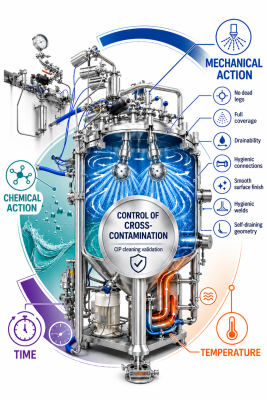
Sinner’s Circle provides a useful framework for understanding CIP requirements and the role of the CIP station in meeting them. Its four factors—mechanical action, chemical action, temperature and time—help relate process requirements to the functions a CIP station must provide: fluid supply and recirculation, controlled detergent dosing, temperature control, automated cleaning sequences and recording of critical cleaning parameters.
Mechanical Action
In a CIP system, mechanical action is one of the most important factors determining cleaning effectiveness. CIP is not simply a cleaning procedure: effective cleaning depends on the hygienic design of the production equipment itself. Mechanical action provides the hydraulic energy needed to dislodge and remove residues adhering to process surfaces.
This requires turbulent flow in the pipework, normally at velocities above 1.5 m/s. A design velocity of around 2 m/s is common, providing a safety margin against possible flow-rate deviations.
The effectiveness of this mechanical action depends directly on the hygienic design of the installation. Dead legs, areas where material accumulates because of inadequate drainage, rough surfaces or areas not reached by spray devices with sufficient impact can compromise cleaning even when hydraulic parameters are correct.
Hygienic design is therefore essential if mechanical action is to be effective.
The Role of the CIP Station
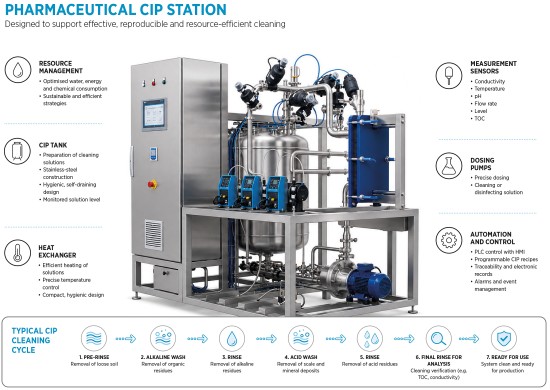
For mechanical action, the CIP station provides consistent, verifiable control of the flow rates, velocities and pressures needed to achieve the cleaning conditions established during design.
Automated recipes and continuous recording of critical parameters support process repeatability. Relevant controls also include data integrity, user access, audit trails, recipe management and validation of the computerised system.
Chemical Action
Once mechanical action has dislodged residues, chemical action helps dissolve them and prevents them from redepositing on equipment surfaces. Detergent solutions are therefore formulated to remove different types of residue without damaging construction materials.
Detergent is added to water using dosing pumps that ensure the correct concentration of the cleaning solution.
In designs where detergent is dosed in-line, the CIP station may not require dedicated mixing tanks, reducing the risk of cross-contamination and increasing system flexibility.
Working concentrations are established through development studies and supplier instructions, taking account of material compatibility, water quality, the amount of residue and the ability to rinse away the detergent solution. Typical concentrations range from 0.5% to 3%. Increasing the concentration above the optimum does not significantly improve cleaning effectiveness but does increase chemical consumption and operating costs.
Two main types of cleaning agents are used:
- Alkaline agents, such as sodium hydroxide or potassium hydroxide, are particularly effective at removing organic residues.
- Acidic agents, such as citric, phosphoric or nitric acid, are used to dissolve mineral deposits, insoluble salts and metal oxides, while also contributing to the passivation of stainless-steel surfaces.
Depending on the product and process characteristics, these formulations may be supplemented with additives such as surfactants and emulsifiers, sequestering and chelating agents, oxidising agents or antifoaming agents to improve overall cleaning performance.
The Role of the CIP Station
For chemical action, the CIP station automatically prepares and doses detergent solutions at the concentration specified for each cleaning recipe. This supports repeatability and reduces the risk of preparation errors.
Operating as a closed system also reduces personnel exposure to concentrated chemicals and helps optimise detergent consumption through controlled dosing and, where the process permits, recirculation for previously validated periods.
Temperature
Temperature acts as a natural accelerator of the chemical reactions occurring during cleaning. Adding energy to the system reduces residue viscosity, making residues easier to dislodge and transport, while improving the solubility and effectiveness of detergent solutions.
However, temperature must be selected on technical grounds and qualified for the specific formulation. It must be sufficiently high to exceed the melting point of any lipids in the residue. Where detergents contain non-ionic surfactants, it must exceed the temperature at which the surfactant begins to act as an antifoaming agent. Excessively exceeding that temperature, however, can reduce solubility and detergency or cause phase separation, compromising cleaning effectiveness. An excessively high initial temperature can also have the opposite of the intended effect, promoting the denaturation and deposition of protein residues on stainless-steel surfaces and making their subsequent removal more difficult.
The Role of the CIP Station
For temperature control, the CIP station heats and maintains cleaning and rinsing solutions at the specified temperature for each process stage. Precise, reproducible control supports detergent effectiveness, limits deviations between cycles and enables each recipe to be executed under consistent operating conditions for validation.
Time
Time is the fourth factor in Sinner’s Circle. It represents the period during which each stage of the cleaning process takes place under the specified flow, temperature and detergent-concentration conditions. Defining it correctly is essential to allow chemical reactions to occur and mechanical action to reach all equipment surfaces.
One of the most important parameters is Dirty Hold Time: the interval between the end of batch manufacturing and the start of cleaning. The longer this interval, the greater the likelihood that residues will dry, adhere more strongly or undergo changes that make them harder to remove. It should therefore be minimised wherever possible.
During the cleaning cycle, the circulation time of detergent solutions must ensure that all pipework and equipment remain under turbulent-flow conditions long enough to remove residues, even in areas with more complex geometries. Likewise, rinsing stages must continue until the detergents and chemicals used have been completely removed.
The Role of the CIP Station
For the time factor, the CIP station automates the cleaning sequence so that each stage—washing, rinsing, circulation or disinfection—runs for the specified, validated duration.
Automation reduces variation between cycles and idle time between stages, supporting process repeatability.
Continuous recording of process parameters provides the documented evidence needed by the Quality Department to review cleaning cycles and release equipment.
From Cleaning Validation to Multiproduct Manufacturing
Although a CIP station can control the four factors of Sinner’s Circle reproducibly, this does not yet answer the original question. Technically effective cleaning does not automatically establish that the same equipment can be used to manufacture different medicines. The next step is to validate the cleaning process and assess the risk of cross-contamination.
Traditional acceptance criteria, such as visual inspection and analysis of the final rinse water, provide initial evidence of cleaning effectiveness and should be supplemented by swab sampling at critical locations. However, when a facility is intended to manufacture different medicines, these criteria alone are insufficient. The risk of cross-contamination must be assessed, and exposure limits must be established for each active ingredient on the basis of toxicological criteria (HBEL: Health-Based Exposure Limits).
This assessment draws on concepts such as Permitted Daily Exposure (PDE), which defines an acceptable daily exposure to an active ingredient, and Maximum Allowable Carryover (MACO), which establishes the maximum amount of a product that may be carried over into the next batch without compromising its safety.
Compliance with these limits must be verified using validated sampling methods: analysis of final rinse water and, because rinse-water analysis does not always represent residues adhering to equipment, swab sampling at locations representative of the worst case from a hygienic-design perspective. These are supported by analytical techniques such as TOC, conductivity or specific methods where required by the nature of the active ingredient.
Highly Potent Active Pharmaceutical Ingredients
When a facility manufactures medicines containing highly potent active pharmaceutical ingredients (HPAPIs), risk management becomes even more important. In these cases, a risk matrix is commonly established to group products according to their toxicity (HBEL, PDE), cleanability and the difficulty of removing each product during cleaning.
Validation must be based on the worst case: the product that is most difficult to remove and has the greatest toxicological impact. In addition to verifying CIP system effectiveness, sufficiently sensitive analytical methods—such as HPLC or UV-Vis—must be available to detect extremely low concentrations of the active ingredient.
In some cases, the MACO value may even be below the detection limit of the available analytical techniques.
If the method cannot quantify at the required level, the study does not demonstrate compliance, and additional strategies may be necessary: improving the method, using single-use systems, segregating equipment or providing independent cleaning circuits, or using isolator-based containment solutions for certain process stages.
Conclusion
Returning to the question raised by the pharmaceutical company at the beginning of this article, there is no single or immediate answer. A properly designed and qualified CIP station provides an essential foundation for effective, reproducible cleaning. However, suitability for multiproduct manufacturing also depends on a validated cleaning process and a comprehensive assessment of cross-contamination risks.
The assessment must be based on a risk-management strategy, robust toxicological data for the medicines to be manufactured and continuous monitoring of analytical results. Only then can the safe operation of a multiproduct facility be supported by documented evidence.
In practice, this risk management often translates into specific production strategies. One of the most common is to group products with similar toxicological characteristics and cleaning requirements, always applying the most stringent cleaning conditions within the group.
Where this is insufficient—for example, when manufacturing cytotoxic products or other HPAPIs—independent cleaning circuits, containment systems or even segregated production areas may be required.
Ultimately, the challenge in a multiproduct facility is not simply to clean equipment effectively, but to demonstrate through technical and documented evidence that each new batch can be manufactured without unacceptable cross-contamination risk. This is the fundamental distinction between effective cleaning and a validated cleaning process.
References
- ASTM E3219 Standard Guide for Derivation of Health Based Exposure Limits (HBELs).
- ASTM E3106 Standard Guide for Science Based and Risk Based Cleaning Process Development and Validation
- (s. f.). Modernizing Cleaning Validation: 3 Strategies to Protect Quality, Ensure Compliance & Drive Performance [eBook]. Ecolab Inc.
- European Hygienic Engineering and Design Group (EHEDG). (2025). Hygienic Design Principles (EHEDG Guideline 8, 4.ª ed.). Ámsterdam, Países Bajos: EHEDG.
- Alconox Inc. (2024). The Aqueous Cleaning Handbook: A Guide to Critical Cleaning Procedures, Techniques, and Validation (5.ª ed.). White Plains, NY: AI Technical Communications.
- Schiffmann, A., Luy, B., Bättig, M., & Leuenberger, H. (2000). WIP/CIP and Closed Equipment Systems in the Field of Pharmaceutical Solid Dosage Forms. Pharma Technologie Journal, (1080), 206–223.
- Seiberling, D. A. (Ed.). (2008). Clean-In-Place for Biopharmaceutical Processes. Nueva York, NY: Informa Healthcare USA, Inc.
- Walsh, A. (s. f.). Steps for Proper Cleaning Validation in Life Sciences (Capítulo 8).
- World Health Organization (WHO). (2020). Points to consider when including Health-Based Exposure Limits (HBELs) in cleaning validation. En WHO Expert Committee on Specifications for Pharmaceutical Preparations: Fifty-fifth report (Technical Report Series, No. 1033, Annex 2). Ginebra, Suiza: WHO.